
• 787-923-6017 (for English) • 787-923-6015
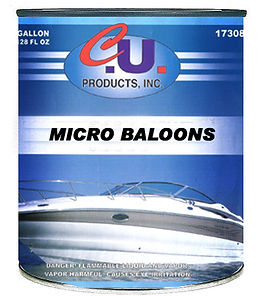
MICRO-BALLOON FILLER is ideal for thinning epoxy and poly- ester resins to make fillets or repairing surface imperfections. The ratio of microballoons to epoxy is a three-to-one mixture.
Product Features:
-
Ultra-light extender makes epoxy or polyester resins lighter and more sandable.
-
Great for joints and fillets, or surfacing over imperfections in wood grain or in fiberglass cloth.
-
Convenient spout offers easy, no-waste pouring for clean,no mess use.
-
Compatible with aliphatic resins and acetone based glues.
Everything Else You Need...


CAB-O-SIL® fumed silicas are used as rheological control agents in a variety of liquid resin formulations. Our products control viscosity, thixotropy, flow, sag resistance and sedimentation.


Fiberglass Repair Kit
It is used to repair small holes in damaged fiberglass. Common areas to find damaged fiberglass include boats, tubs, and automobiles. Bondo is a company that sells an effective kit for making this type of repair. The kit comes with replacement fiberglass resin, a liquid hardener, and a plastic spreader. The liquid resin will be poured into the damaged area of the fiberglass and smoothed out until the entire area that been covered.

CU Products has the soluton you need in the correct sizes, at the right prizes...
¡No one can beat us in Quality Products and Services!
For more information on our resins and / or composites, please refer to this PDF Manual
For more information on our resins and / or composites, please refer to this PDF Manual

Talc
Talc is an inexpensive filler used to transform resin into an easily spreadable paste or putty. Talc increases weight, and stiffness. Use to extend resin, reduce shrinkage and sanding effort. Use for a faring compound and to fill voids where weight is not a consideration.
A ratio of one to one by volume will produce a thickened liquid that flows and can be used for potting. A ratio of two portions of talc to one resin produces product of peanut butter consistency. The addition of a small percentage of fumed silica will reduce resin drainage and assist spreading properties. Various resin systems will react differently so experiment before proceeding to large projects.
Proper sequence for mixing filled compounds is to first measure catalysts or hardener into resin and mix thoroughly. Next, add fiber reinforcements and mix to assure complete fiber wet out. Fillers such as Talc follow, with fumed silica added last. Mix well. Fumed Silica can contribute to difficulties in
sanding. Where sanding will follow, use only as much fumed silica as is required to impart thixotrophy. Thick layers or large pours can create considerable exothermic heat, proceed with caution.